
Property Investment
Which Market Offers Better Property Investment Opportunities: Bali or Dubai?
When comparing international real estate markets, Bali and Dubai are among the most attractive destinations for foreign investors. Both markets offer opportunities for rental income and long-term capital appreciation, but they differ significantly in terms of entry price, market maturity, rental strategy, and future growth potential.
If you're considering investing in overseas property, here's how Bali and Dubai compare
A| Lower Entry Price
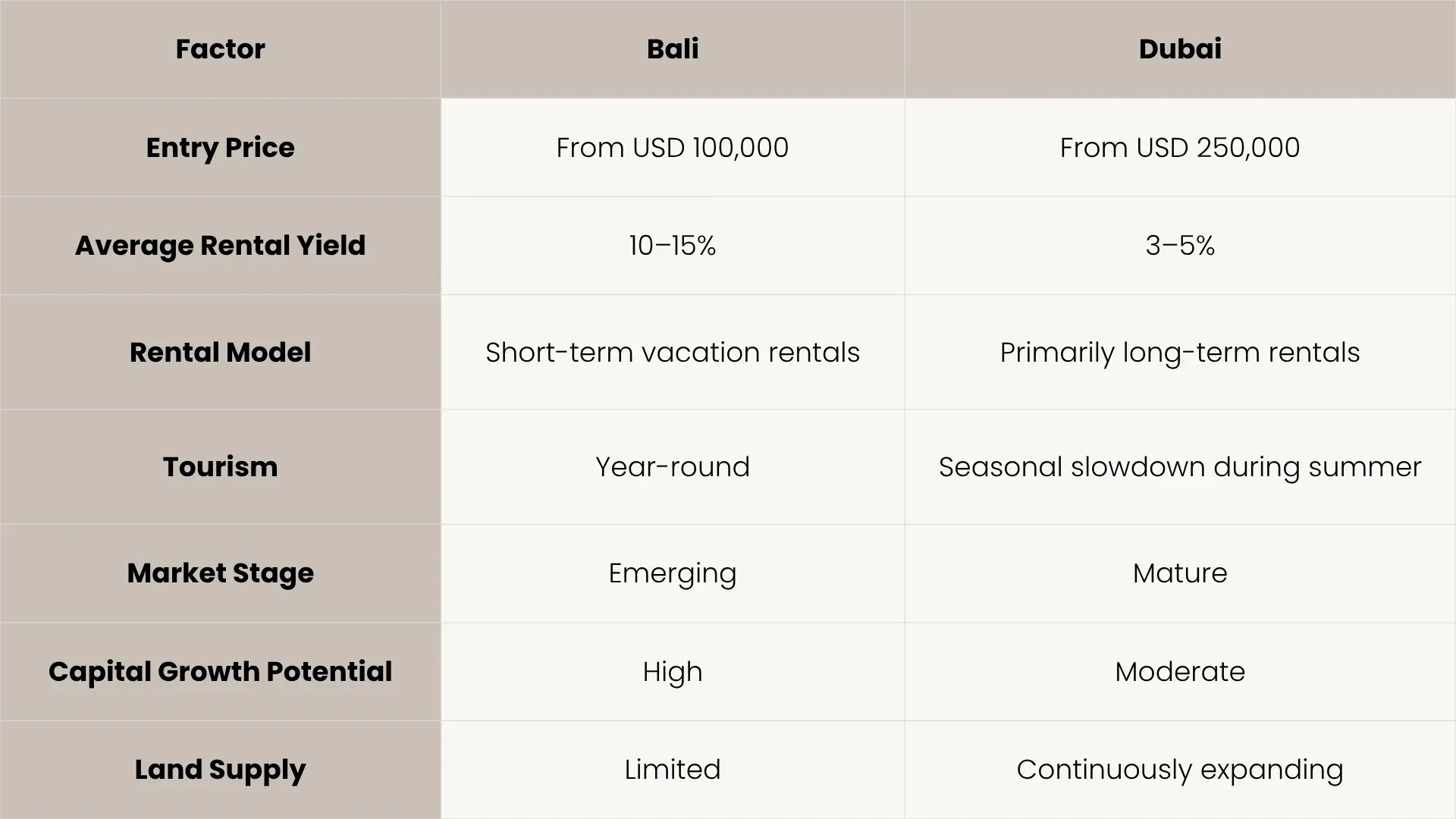
One of Bali's biggest advantages is its accessibility. Investors can purchase a modern investment villa starting from USD 100,000, with premium one- and two-bedroom villas typically ranging between USD 100,000 and USD 250,000, depending on the location and stage of construction.

In Dubai, entry prices are significantly higher. Apartments generally start from around USD 250,000, while villas in established communities require a much larger investment. For investors looking to diversify their portfolio without committing substantial capital, Bali offers a considerably lower barrier to entry.
B| Higher Rental Returns
Rental income is one of the main reasons investors purchase overseas real estate. In Dubai, residential properties are primarily purchased for long-term rentals, with average rental yields typically ranging between 3–5% per year, depending on the location, service charges, and property type.
Bali follows a different investment model. The island's property market is driven largely by short-term vacation rentals, where professionally managed villas can generate 10–15% annual returns. In addition, some developments offer guaranteed rental income during the first years of ownership, providing greater confidence for investors.

C| Year-Round Tourism
One of the biggest differences between the two markets is seasonality. Dubai experiences a noticeable slowdown during the summer months due to extremely high temperatures, which affects tourism and short-term rental demand.
Bali enjoys a tropical climate throughout the year. Although there are high and low seasons, tourism never stops. The island attracts surfers, digital nomads, entrepreneurs, families, honeymooners, and wellness travelers every month of the year. This creates a more stable demand for short-term rentals and helps maintain stronger occupancy rates throughout the year.
D| Growing Tourism Industry
Bali continues to strengthen its position as one of the world's most popular travel destinations.
International tourism continues to grow as the island attracts visitors from Europe, Australia, the Middle East, North America, and Asia. Ongoing investment in infrastructure, hospitality, and lifestyle developments further supports this growth.
A continuously expanding tourism sector creates long-term demand for high-quality rental properties, making Bali particularly attractive for property investors.

E| Limited Land Supply
Unlike Dubai, where new districts and artificial islands continue to increase the supply of land, Bali has a naturally limited amount of developable land. Prime locations near the ocean, rice fields, and established lifestyle hubs become increasingly scarce each year

As demand continues to grow while supply remains limited, land values have strong long-term appreciation potential. For investors, this creates an important advantage: scarcity supports future price growth.
F| Market Growth Potential
Dubai is widely regarded as a mature and well-established real estate market. While it continues to attract investors from around the world, property prices have already experienced substantial growth over the past two decades.
Bali, by contrast, is still an emerging market with significant room for expansion. New infrastructure projects, increasing international demand, and the development of new investment areas continue to drive property values upward.
Many investors choose off-plan developments, allowing them to purchase at today's prices while benefiting from capital appreciation as construction progresses.
G| Geopolitical Stability
Geopolitical stability has become an increasingly important consideration for international investors. Indonesia is generally recognized as one of Southeast Asia's most politically stable countries. Geographically, Bali is located far from major global conflict zones, providing an additional sense of security for long term investors.
Combined with a stable tourism industry and continued international demand, this makes Bali an attractive destination for investors seeking both financial returns and long-term confidence.

H| Conclusion
Both Bali and Dubai offer attractive real estate investment opportunities, but they appeal to different investment strategies. Dubai is well suited for investors looking for a mature, highly regulated market focused on long-term stability. Bali may be the better choice for those seeking:
- Lower entry prices, starting from around USD 100,000
- Higher rental yield potential of 10–15%
- Strong demand driven by year-round tourism
- Limited land supply supporting long-term appreciation
- An emerging market with significant growth potential
- A stable geopolitical environment
As Bali continues to develop and attract international investors, it remains one of the most promising real estate markets in Asia, offering a unique combination of affordability, rental income, and future capital growth.